æroom
Intelligent control for connected spaces.
- Role
- Designer & Developer
- Year
- 2024
- Team
- With Julien Offray & Yannick Schwab
- Tools
- ESP32, Node.js, MQTT, MongoDB
Overview
æroom is a full-stack IoT platform for monitoring and controlling indoor climate and air quality across multiple rooms. It connects hardware sensors to a web interface through a complete data pipeline — from physical device to database to UI.
Problem
IoT systems are typically either consumer products (limited, closed) or developer tools (powerful, inaccessible). The course brief asked us to build a connected system from scratch — hardware, backend, and frontend — treating the technical complexity as a design problem in itself.
Process
The project ran two tracks simultaneously: hardware integration and software architecture.
On the hardware side, we configured ESP32 microcontrollers with three sensor types — temperature, dust particles (PM2.5), and air quality (VOC). Getting reliable readings and managing the radio transmission were the first challenges to solve before any UI work could begin.
On the software side, we chose MQTT as the data transport layer (lightweight, real-time, designed for IoT), with a Node.js broker processing incoming data and writing to MongoDB. This gave us persistent storage and queryable history.
The UI design challenge was about information density and access control — multiple rooms, multiple devices, multiple users, with granular sharing permissions.
Solution
The platform supports:
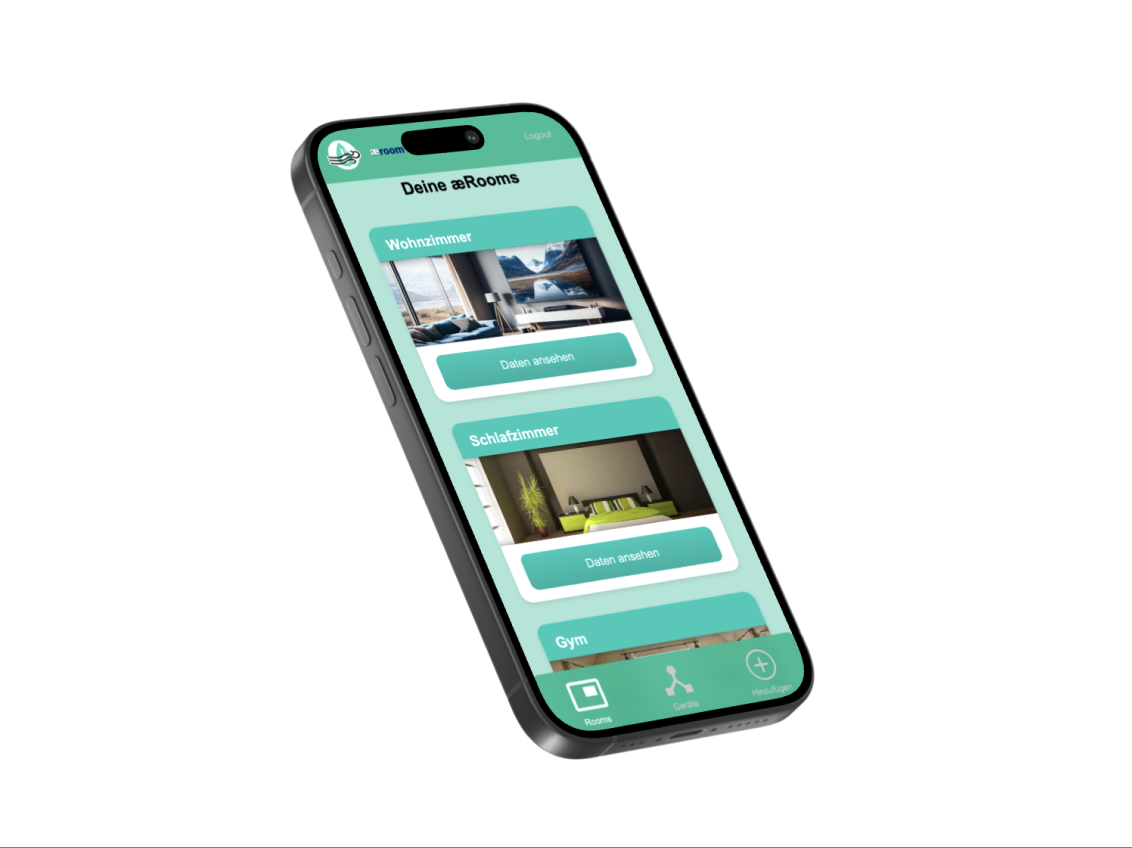
- Multi-room dashboard: All rooms and their live sensor readings in a unified view
- Device management: Add, remove, and configure sensors per room
- Family sharing: Share room access with other accounts via key-based permissions
- Data history: Timestamped readings stored in MongoDB, queryable over time
Authentication gates all data access — only authorized users can view or control specific rooms. The UI abstracts the technical complexity (MQTT topics, sensor IDs, database queries) behind a clean, room-centric interface.
Outcome
æroom was primarily a technical achievement — proving that a complete IoT stack could be built and understood end-to-end. But the design constraint of "hide the complexity" was equally important. The project reinforced that building something functional and building something usable are two distinct challenges, and both matter.