BeeSmart
The digital co-pilot for beekeeping.
- Role
- Designer & Developer
- Year
- 2024
- Team
- With Julien Offray & Yannick Schwab
- Tools
- Figma
Overview
BeeSmart is an AI-powered mobile app designed to support beekeepers — especially beginners — in managing Varroa mite infestations and tracking hive health over time. It functions as a digital co-pilot: part intelligent assistant, part long-term logbook.
Problem
Varroa mite infestation is one of the most serious threats to bee colonies worldwide, and managing it correctly requires consistent monitoring and timely treatment. Beginner beekeepers often lack the knowledge to recognize warning signs or interpret infestation data — and existing tools are either too complex or too generic.
The challenge: design an app that is genuinely useful to someone who has never kept bees, without being condescending to experienced beekeepers.
Process
We started with extensive user research — interviews with beekeepers at different experience levels, and field observations during hive inspections. This grounded the design in real workflows and real pain points rather than assumptions.
Key insights from research:
- Beginners need guidance at the moment of inspection, not after
- Experienced beekeepers want data history and trends, not explanations
- Both groups want fast, friction-free data entry during hive work (gloves on, outdoors)
These insights drove the information architecture: the app needed to adapt its depth to the user's level without requiring manual configuration.
Solution
The final Figma prototype covers:
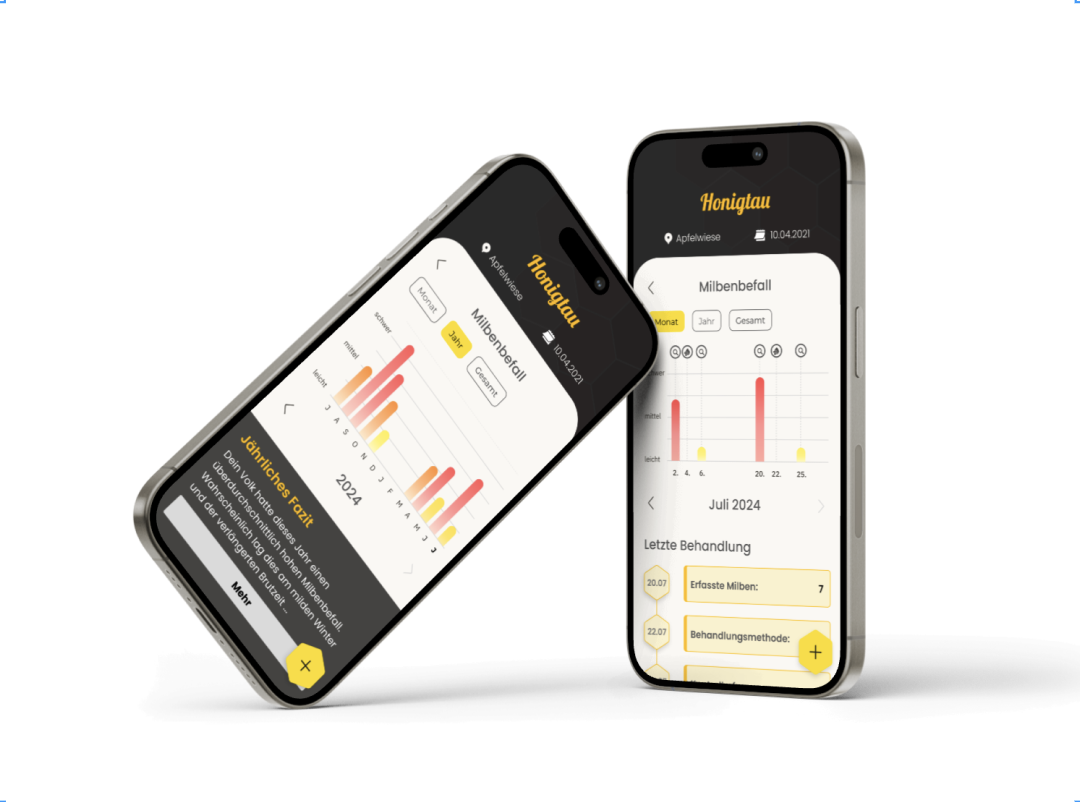
- AI-powered mite analysis: Users input infestation counts and receive AI-guided treatment recommendations with timing and dosage
- Hive logbook: Every inspection is recorded automatically, building a long-term dataset per hive
- Trend visualization: Multi-year charts show infestation patterns over time, enabling data-driven decisions
- Adaptive UI: Novice mode surfaces guidance and explanations; advanced mode prioritizes raw data and quick entry
The interface was designed for outdoor use — high contrast, large touch targets, minimal text entry.
Outcome
BeeSmart demonstrated how rigorous user research translates into design decisions that would have been invisible without it. The dual-audience problem — designing for beginners and experts simultaneously — required solutions that many apps avoid by just picking one. The project also showed how AI can add genuine value in a niche domain when the prompting and context are done thoughtfully.