Checkit – Conscious Food Intelligence
Built in Silicon Valley — an AI-powered food health app that goes beyond nutrition labels to help people make truly informed choices.
- Role
- UI Design Lead
- Year
- 2024
- Team
- 3 person team + external startup founder
- Tools
- Figma
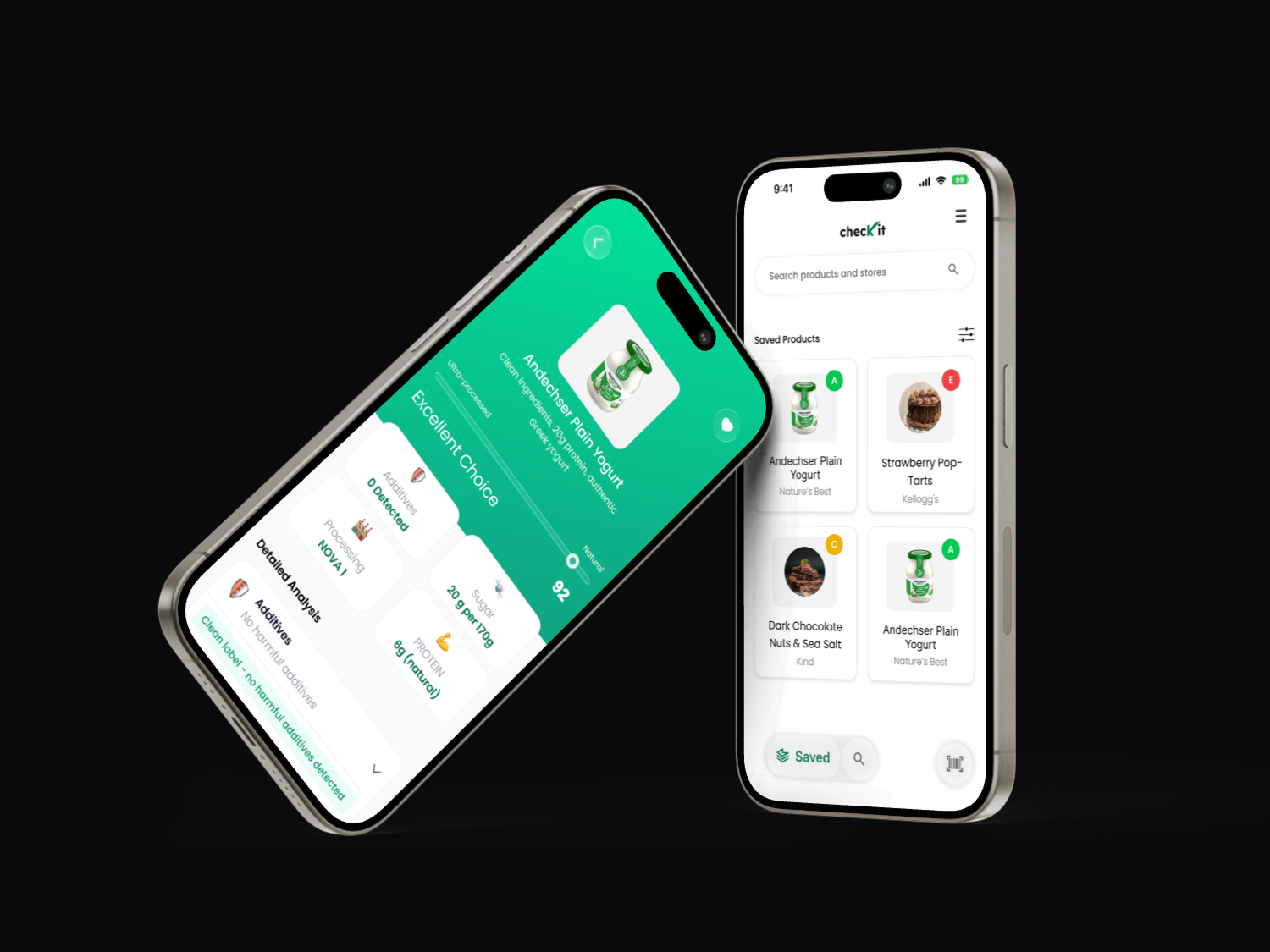
Overview
Checkit was born out of a frustration I experienced firsthand during my exchange semester at San Jose State University in the heart of Silicon Valley. Coming from Germany, I was struck by how opaque and inconsistent food safety standards are in the US — a lot slips under the radar, and most people simply don't have the tools or knowledge to understand what certain ingredients do to their bodies over time. We built Checkit to change that.
The project emerged organically — part university course in UI Design, part passion project — and grew into something real when a startup founder joined our three-person team and adopted our designs and concepts as the foundation for his company.
The Problem
Nutrition labels tell you calories and macros. They don't tell you whether an ingredient has been linked to long-term health risks, whether it conflicts with your personal allergies or conditions, or whether the product you're holding is simply a bad choice for you specifically. People are left to navigate this alone, often without the knowledge to do so.
The Vision
Checkit works in two contexts:
In the supermarket: Ultra-low friction. Open the app, scan a product, get an instant AI-powered verdict — not a wall of numbers, but a clear health rating tailored to you, your allergies, and your health profile. Flagging future damage from ingredients that accumulate over time, not just what's bad right now.
At home: A deeper layer for people who want it. Research mode — articles, expert opinions, ingredient deep-dives. Preparation for your next shopping trip. Building long-term food awareness, not just reactive scanning.
My Role
UI Design lead in a team of three. I was responsible for the end-to-end interface design — from early concept through high-fidelity screens — while collaborating closely with the team on product thinking and feature definition. The project ran alongside a UI Design course at SJSU, which gave us structured feedback and critique throughout.
Context
San Jose State University Exchange — Silicon Valley, Semester 7. The designs were picked up by an external startup founder as the foundation for a real product — one of the most validating outcomes I've had from a university project.